Private credit in Australia: A maturing sector
Private credit in Australia: A maturing sector

Private credit in Australia: A maturing sector
Australia’s private credit sector is rapidly evolving amid tightening regulations, shifting interest rates, and robust market growth.
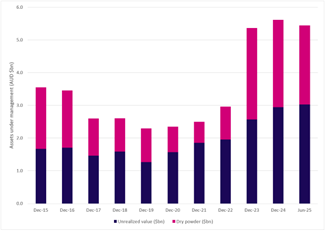
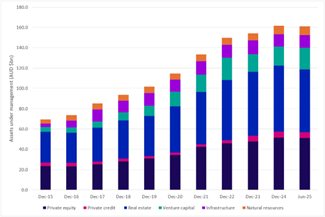
Preqin data highlights the rapid growth and diversification of Australia’s private credit market. Australia-focused closed-end private credit assets under management (AUM) reached A$5.4 billion as of June 2025, double what it was around three years ago, according to Preqin (Fig. 1). Private credit accounts for 3% of Australia-focused total private capital AUM (Fig. 2).
Fig. 1: Australia-focused closed-end private credit AUM stands at AU$5.4bn
Australia-focused closed-end private credit AUM, Dec 2015 – Jun 2025
Source: Preqin Pro. Data as of January 2026
Fig. 2: Australia closed-end private credit accounts for 3% of its total private capital AUM
Australia-focused private capital AUM by asset class, Dec 2015 – Jun 2025*
Source: Preqin Pro. Data as of January 2026
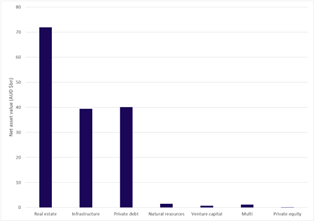
Separately, Australia-focused open-ended private credit stands at A$40 billion in net asset value as of December 2025 (Fig. 3), almost twice what it was as of May 2025 (A$25 billion).¹ These figures do not include private lending to property developers, which CBRE estimates to be about A$50 billion.²
Globally, private credit is seeing continued growth amid recent developments in the asset class. AUM stood at US$2.1 trillion (A$3.2 trillion) at the end of 2024 and is projected to reach US$4.5 trillion (A$6.8 trillion) by 2030, according to Preqin’s Private Markets in 2030 report.³ Growth drivers include investors seeking portfolio diversification and increasing familiarity with private credit.⁴
Fig. 3: Preqin tracks 126 Australia-focused open-ended private credit funds with over AU$40bn in NAV
Australia-focused open-ended net asset value as of Dec 2025
Source: Preqin Pro. Data as of January 2026
While Australia’s closed-end market is less mature, high interest rates and tighter regulatory oversight are tailwinds for private credit’s growth.
The Reserve Bank of Australia raised the cash rate by 25 basis points in February 2026 to 3.85%, reversing rate cuts delivered in 2025.⁵ This higher-rate environment has the potential to make private credit yields more attractive to investors as most private credit loans are floating-rate. The asset class may therefore provide investors with a steady source of income, as well as diversification benefits.
High interest rates are associated with greater pressure on debt-servicing capacity and could lead to weaker borrowers being filtered out.⁶ Higher rates could therefore encourage prudent borrowing and financial discipline, provided lending standards and governance remain robust.
At the same time, while the Australian Securities & Investments Commission (ASIC) has recognised that private credit is beneficial for Australia’s economy when done well, the sector has recently come under greater scrutiny. Following a surveillance of private credit funds between October 2024 and August 2025, ASIC concluded that although the market is growing rapidly, inconsistent governance, valuation, disclosure and fee practices warrant stronger standards and more active regulatory intervention to protect investors and maintain market integrity.
Global Investment Institute’s upcoming Private Credit Investment Forum will take place on Thursday, 14 May 2026 in Melbourne CBD, Victoria. To register your interest in attending, click here or for more information email zlatan@globalii.com.au.
COMPLIMENTARY ACCESS TO PREQIN PRO PRIVATE CREDIT MODULE
As part of our partnership with Preqin, delegates joining our Private Credit Investment Forum may receive complimentary access* to the Private Credit module within Preqin Pro.
The trial includes access to:
Private debt fund profiles across direct lending, mezzanine, special situations, distressed debt, fund of funds, and venture debt strategies
Net-to-LP performance data, including IRR, multiples, quartile rankings, capital calls, distributions, cash flows
Market, PME, and custom benchmarks to support comparative analysis and portfolio assessment
This data can be used to support manager selection, portfolio construction, and allocation analysis. For more information click this link, or alternatively please contact Nicole Browne at nicole@globalii.com.au.
*Complimentary access is subject to eligibility. Preqin reserves the right to determine participant eligibility and may decline access where appropriate. Free trial access is provided for a limited period of up to two (2) weeks.

Global Investment Institute is Australia’s leading provider of conferences for capital allocators.
We connect institutional investors, family office and private wealth investment leaders with peers and global investment experts to share knowledge and thought leadership in a private, collegiate and discussion-focussed setting, conducted under Chatham House Rule.
Our upcoming events include:






¹ Australian Private Capital 2025 Yearbook: A Calm Port in a Wild Storm, Preqin, May 2025
² Private Credit in Australian Real Estate, CBRE, June 2025
³ Private Markets in 2030, Preqin, October 2025
⁴ Private Credit: A primer on a broadening asset class, BlackRock, January 2026
⁵ Reserve Bank of Australia cash rate target, February 2026
⁶ Federal Reserve Board report, Financial Stability Report, November 2025
References
Australian Private Capital 2025 Yearbook: A Calm Port in a Wild Storm, Preqin, May 2025
https://www.preqin.com/insights/research/reports/australian-private-capital-2025-yearbook-a-calm-port-in-a-wild-storm
Private Credit in Australian Real Estate, CBRE, June 2025
https://www.cbre.com.au/insights/reports/private-credit-in-australian-real-estate
Private Markets in 2030, Preqin, October 2025
https://pro.preqin.com/insights/research/reports/private-markets-2030
Reserve Bank of Australia cash rate target, February 2026
https://www.rba.gov.au/
Federal Reserve Board, Financial Stability Report, November 2025
https://www.federalreserve.gov/publications/financial-stability-report.htm
ASIC report, Private credit surveillance report: Retail and wholesale surveillance, November 2025
https://www.asic.gov.au/regulatory-resources/find-a-document/reports/rep-820-private-credit-surveillance-report-retail-and-wholesale-surveillance/
Private Credit: A primer on a broadening asset class, BlackRock, January 2026
https://www.blackrock.com/institutions/en-global/institutional-insights/thought-leadership/a-primer-on-a-broadening-asset-class
If you have enjoyed reading this article, please subscribe to GII Insights, delivered monthly, direct to your inbox and it is FREE!
Disclaimer
The views and opinions expressed in this publication are those of the individual contributors and their respective organisations at the time of publishing. They do not necessarily reflect those of Global Investment Institute (GII). These views are not intended to be, and should not be construed as, investment advice or research. They are subject to change without notice, and no representation is made as to their ongoing accuracy or reliability. Forecasts, forward-looking statements, or opinions are inherently uncertain and based on assumptions, risks, and external factors which may change over time. The individuals interviewed have no obligation to update any statements made.
International investments carry additional risks, including potential loss of capital, currency fluctuations, differences in accounting standards, and economic or political instability.
All information contained in this publication is general in nature and does not take into account the financial objectives, situation, or needs of any individual or organisation. It should not be used as the sole basis for making investment decisions. GII strongly recommends seeking independent, fee-for-service financial advice before acting on any information contained herein.
Contributors, guest writers or interviewees may hold personal or professional financial interests in the investments discussed. The editorial team has assessed that these interests have not influenced the content of this publication.
All content featured in this publication is protected by copyright. No part may be reproduced, distributed, or transmitted in any form without prior written permission from the Global Investment Institute.