Expanding asset allocation into illiquid markets

Zoe McHugh, Portfolio Manager, QIC

Equities have benefited from historically low discount rates over the past decade, and we are mindful that the excess returns we have all experienced in the past few years will not continue into perpetuity. For that reason, we are continuing to expand our asset allocation into more illiquid markets, where QIC has had investment expertise for many years.

Read More


The changing asset mix and the importance of a differentiated offering in an evolving operating environment

Geraldine Barlow, Independent (non-executive) Investment Committee Member, Future Super & Centric Wealth

The focus on lowest cost outcomes in superannuation may not always produce the optimal outcome for beneficiaries. Further improvement is required from all sides of the industry to ensure the Your Future, Your Super regulations truly align to delivering best outcomes for members. From an investment perspective, the asset allocation mix for many asset owners across the globe will likely see a continued increase in allocations to private markets. A trend that is only likely to increase given the search for yield, and the attractive capital market features of these investments relative to public markets.

Read More
Perspectives on Your Future Your Super legislation from a superannuation fund leader

Kate Farrar, Chief Executive Officer, LGIAsuper

The asymmetric payoff of the legislative design of Your Future Your Super will drive superannuation funds to take less risk against their Strategic Asset Allocation decisions. This will likely push funds towards more passive investing and more fee-efficient and low tracking-error positions, which may cut out some really high-performing sources of returns for members, which they have been able to access over the past decade.

Read More
Future proofing culture and investment capability to thrive in a fast changing world

Lisa Gray, Chief Executive Officer, Victorian Funds Management Corporation (VFMC)

At this point we are reconsidering the role that traditional defensive assets should play in the portfolio, as well as how best to meet clients’ long-term objectives in a reinforced lower for longer macroeconomic outlook. We still believe that a long-term investment horizon provides material advantages in generating better investment outcomes, but we recognise that historical relationships may change in particular environments and we need to have portfolio flexibility to enable us to adapt to different scenarios.

Read More
Impact on the asset allocation mix from pursuing a reduction in portfolio carbon intensity

Deb Barnes, Managing Director, Capital Markets Risk, OMERS (Toronto, Canada)

Climate change is one of the most pressing issues of our time and represents both significant risk and opportunities. Across the organisation, OMERS is finding opportunities to invest in, and partner with well-run organisations who share our sustainable and environmentally responsible mindset. We have also recently announced a commitment to reduce the carbon intensity within our portfolios by 20%, by 2025. An ambitious target which needs to be managed in a measured and thoughtful manner to ensure we continue to deliver on the pension promise.

Read More
Diversity pays: A great positive externality with the added bonus of higher returns

Alexandra McGuigan, Global Development Director, 100 Women in Finance; Chair, Global Investment Institute Virtual Roundtables

Alexandra is the host of GII’s virtual roundtables and the Global Development Director for 100 Women in Finance, responsible for achieving the company’s ‘Vision 30/40’, which aims to have women represent 30% of investment teams and executive leadership positions by 2040. GII is delighted to partner with Alexandra in helping to achieve this vision towards greater diversity and inclusion across our industry, which creates positive externalities and the added benefit of higher returns also.

Read More
Challenging existing paradigms in a fast changing world

Paul Newfield, Director of Sector Research, Frontier

Today, the speed and pace of change means we need to be deft, nimble and open to challenging existing paradigms. Secular themes are driving the agenda of Paul’s work from the top down, with a focus on climate aligned strategies, exploring new Asian strategies across asset classes, niche real estate strategies and specialised alternative strategies.

Read More
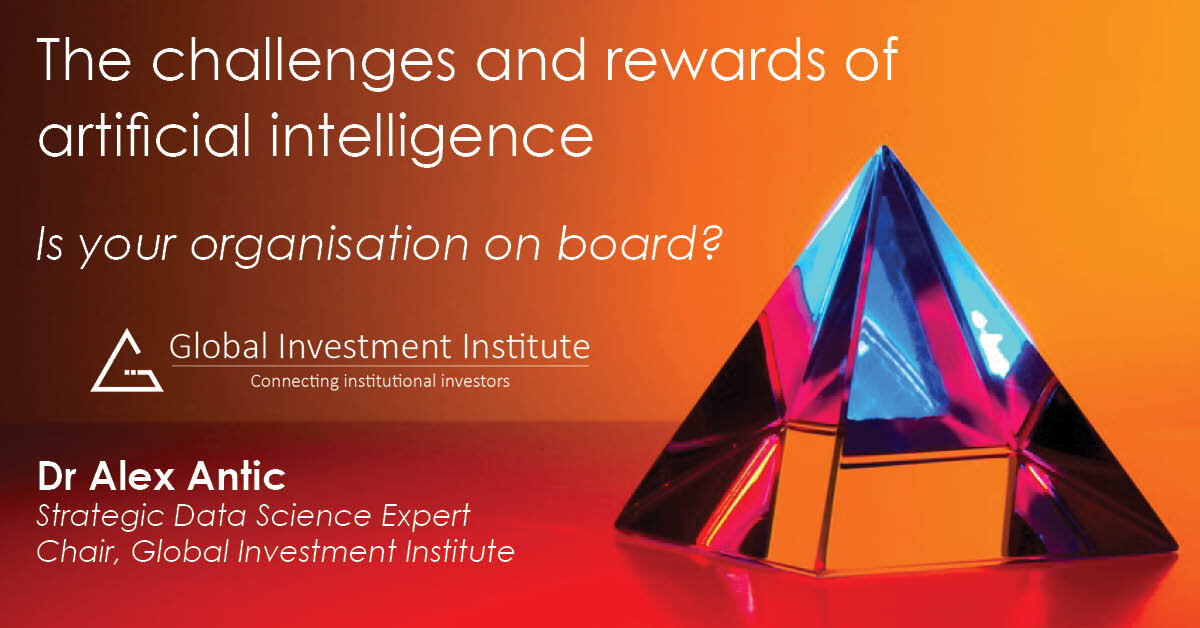
The challenges and rewards of AI: Is your organisation on board?

Dr Alex Antic, Strategic Data Science Expert; Chair, Virtual Roundtables, Global Investment Institute

It has become clear to most organisational leaders that data and analytics is integral to not only staying ahead of their competition, but to simply be in the game! However, establishing a successful, scalable and sustainable AI capability can be challenging.

Savvy organisations have realised that having a governance process and framework to support AI and intelligent automation - especially AI ethics - is mandatory, and not simply a check-box exercise. In this article, Dr Alex Antic discusses what organisations need to do to truly reap the benefits of AI in a responsible and scalable way.

Read More
The changing portfolio mix in a negative real yield world

Joe Kalish, Chief Global Macro Strategist, Ned Davis Research (NDR)

Given the negative real yields throughout the developed world, fixed income will not provide the kind of returns investors have experienced in recent years. Furthermore, bonds may not provide the same degree of hedging protection against negative equity outcomes.

Investors will likely need to reduce their allocations to fixed income and cash and consider having a greater exposure to a broader array of asset classes, including private credit, private equity, venture capital, housing, commodities, gold, and crypto.

Read More
Profits over prophets: Seeking opportunities and mitigating risks in turbulent equity markets

Sunil Thakor, Senior Portfolio Manager, Research Analyst, Sands Capital

Read our Q&A profile interview with Sunil where he shares his unique insights on what is driving global equity markets right now; the types of businesses investors ought to be looking to capture in their portfolios; he discussed themes and trends that are likely to drive long-term growth in equities; and, explained how much emphasis investors should place on where valuations sit relative to fundamentals when deciding where to allocate capital into global equity markets.

We will be hosting a Virtual Roundtable where Sunil will be one of our keynote speakers. To participate in the event taking place on Thursday, 13 May 2021 from 10am-11.15am SHARP (AEST), please register your interest within the article.

NOTE: Participation is strictly limited in number and open only to senior representatives of asset owner organisations.

Read More
Navigating the challenges and opportunities to deliver long-term, sustainable outcomes

Kylie Willment, Chief Investment Officer Pacific, Mercer

The challenge comes from a forward-looking return environment that is likely to generate lower returns than we have been used to, with potentially more volatility and uncertainty as we navigate a post-COVID future.

The opportunity comes through a number of seismic shifts playing out, including the increased focus on sustainable investing, technological evolution and the future of work. Navigating these challenges and opportunities is causing us to focus our attention on a number of key areas.

Read More
Playing to clients' uniqueness to develop investment solutions that give them a competitive advantage

David Surridge, Senior Consultant, JANA

There are always reasons to be optimistic about the future of investing. One of the challenges asset consultants face is the constantly changing investment environment overlayed with changing regulation. Now, more than ever, it is important to help clients utilise their uniqueness. Clients of varying sizes have unique advantages and we try to play to their strengths. For smaller sized clients I am excited about the solutions that we are coming up with to help them compete against the larger funds and stay relevant, in a very competitive environment.

Read More